We build bespoke CRMs for a living, so you might expect this post to end with "and that's why you need one". It won't. Most companies are better served by Salesforce, HubSpot or Zoho, and telling them otherwise is how agencies end up with unhappy clients and abandoned software. What follows is the framework we actually use on discovery calls to decide — sometimes against our own commercial interest — which route fits.
The default answer is buy
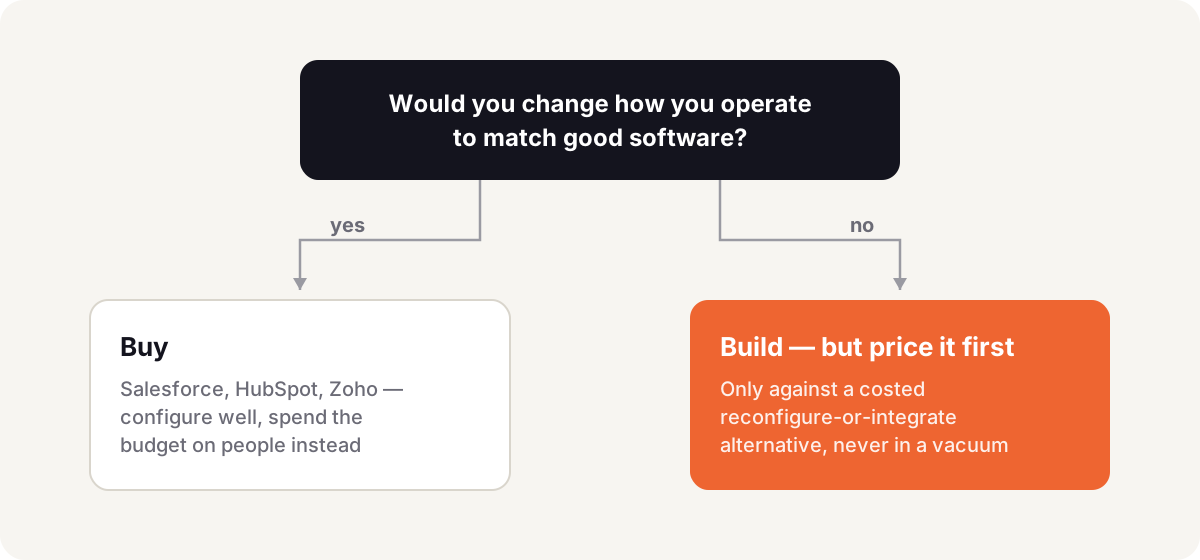
Off-the-shelf CRMs are extraordinary products. Thousands of engineer-years, mature ecosystems, mobile apps, integrations with everything. If your sales process looks like lead comes in → gets qualified → gets contacted → deal closes, buy one, configure it well, and spend your budget on people instead.
You should only think about building when the tool starts fighting the business — and there are specific, recognisable symptoms of that.
The four signals that point to bespoke
Your process is your moat
Some companies win because their operating process is unusual. A lender whose underwriting flow is genuinely different, a distributor whose pricing logic took a decade to refine. Forcing that process into a generic pipeline flattens the very thing that makes the business win. If your team says "the CRM doesn't work the way we work" more than once a week, listen.
The spreadsheet shadow system
The most reliable symptom in the wild: an off-the-shelf CRM officially in place, and next to it a constellation of spreadsheets doing the real work — commission calculations, stock allocations, callback rotas. The CRM has become a place where data is copied to, not worked in. At that point you are already paying for bespoke software; it is just built in Excel, by accident, with no backups.
Per-seat pricing has crossed the build cost
Licence maths is boring and decisive. Sixty seats on a mid-tier plan is roughly £40–70k a year, forever, rising with every hire. A bespoke system is a larger cheque once, then hosting and maintenance. Somewhere between year two and year three the lines cross — if the other signals are present too. Cost alone is never a sufficient reason to build.
Compliance shapes the workflow
Regulated businesses — finance, healthcare, insurance — often need audit trails, data residency and approval chains that generic tools bolt on awkwardly or gate behind enterprise tiers. When the compliance requirements are the workflow, building around them beats configuring against them.
What a bespoke build really costs
Honesty section. A bespoke CRM is not a one-off purchase; it is a product you now own:
- Build is the visible cost — typically three to six months for a system that replaces a shadow-spreadsheet empire.
- Maintenance is the invisible one — plan for 15–20% of build cost per year in evolution, integrations and upkeep.
- Ownership is the organisational one — someone on your side has to own the roadmap, or the system fossilises the 2026 version of your process forever.
If any of those three makes you wince, that is useful information: buy, configure, revisit in two years.
A worked example
A hospitality group came to us running a well-known CRM plus eleven spreadsheets. Bookings lived in the CRM; deposits, supplier allocations and staff rotas lived in the sheets, joined by copy-paste. We did not start by proposing a build. We started with a two-week audit that priced three options: reconfigure the existing CRM (cheapest, fixed 60% of the pain), integrate the sheets into it via middleware (middle), or replace the lot with one system (most expensive, fixed everything including problems they hadn't named). They chose the third — but they chose it against a priced alternative, which is the only way a build decision should ever be made.
The one-question version
If you take nothing else away: would your business change how it operates to match good software, or does the software have to match how you operate? The first answer means buy. The second means build — and you should get the decision priced properly before anyone writes a line of code.