

"AI-powered" has become the most overused phrase in software services. Slapped on a landing page, it can mean anything from "we let Copilot autocomplete our code" to a genuinely different way of running a project. This post is our attempt to be precise about what AI-native development means at Whyphy — where it speeds things up, and where it deliberately doesn't.
What changes with AI in the loop
The honest answer: the shape of the week changes more than the shape of the product.
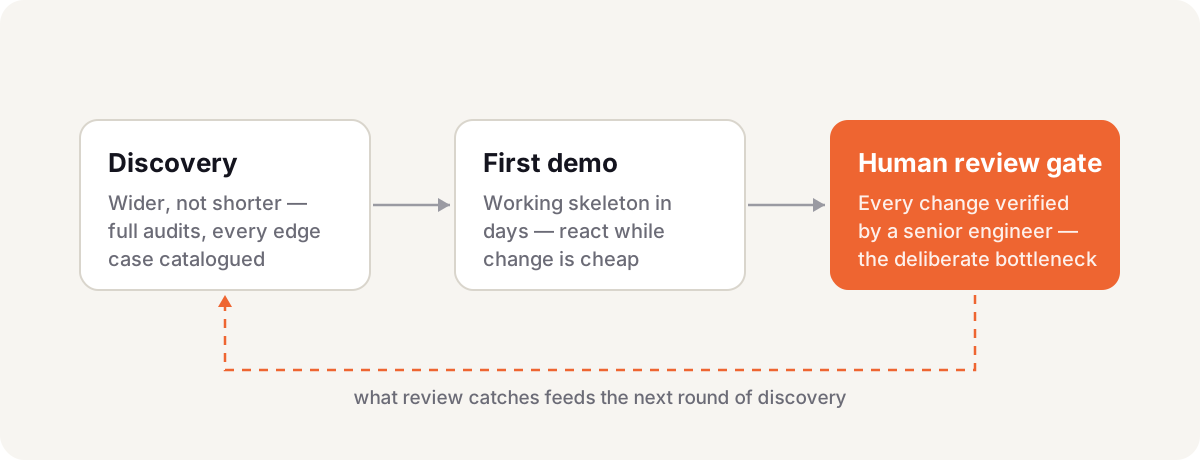
Discovery gets wider, not shorter
Before AI, a discovery phase meant choosing what not to explore. Reading every competitor flow, mapping every edge case in a legacy spreadsheet, transcribing every stakeholder call — there was never time. Now there is. We still spend the same one to two weeks on discovery, but the coverage inside that window is dramatically broader: full audits of existing systems, catalogued edge cases, and requirement documents that trace back to actual quotes from your team.
The first demo arrives in days
Scaffolding, CRUD layers, integrations with well-documented APIs — this is where AI genuinely collapses timelines. A working skeleton that used to take three weeks now takes three days. That matters not because it ships faster (it isn't shippable yet), but because you react to something real in week one, when changing direction is still cheap.
Review becomes the bottleneck — by design
When code is cheap to produce, judgement becomes the scarce resource. Our senior engineers now spend more of their time reviewing, testing and stress-testing than typing. Every AI-assisted change goes through the same review gate as a hand-written one. The throughput gain is real, but it is bounded by how fast a human can verify — and we keep it that way on purpose.
What doesn't change
A few things AI has not changed, and in our view will not:
- Someone still has to decide what to build. AI multiplies execution, not intent. A vague brief produces vague software faster than ever.
- Domain logic is still hand-crafted. Tax rules, settlement flows, inventory reconciliation — the code that encodes your business gets written and tested with full human attention.
- Accountability is human. A named engineer owns every module we ship. "The model wrote it" is not an excuse we ever get to use.
The right mental model: AI is a force multiplier on a disciplined team, and an accelerant on an undisciplined one. It makes good process better and bad process worse, faster.
Questions worth asking any "AI-powered" vendor
If you are evaluating partners, these five questions separate substance from sticker:
- Where in your process does AI actually sit — and where is it banned?
- Who reviews AI-assisted code, and what does that review check?
- How do you keep our proprietary code and data out of third-party training sets?
- Which parts of our project will be slower because you refuse to automate them?
- Can we see a project where AI-assisted speed created a problem, and how you caught it?
A vendor with real practice answers these in specifics. A vendor with a sticker changes the subject.
Where this lands for your project
The practical outcome of an AI-native process is not a discount — it is a different allocation of the same budget. Less of your money goes to boilerplate and scaffolding; more goes to discovery, domain logic, testing and polish. Timelines compress most at the start (first demo, first integration) and least at the end (hardening, launch), which is exactly the shape you want: fast feedback early, no shortcuts late.
If you want to see what that looks like against your own roadmap, talk to us — we will map it out against a real milestone plan, not a slide.